Guides / 未分类
Twin-Shaft vs Intensive Mixer for an Ash Stabilization Plant: How to Choose
Twin-shaft or intensive mixer for an ash stabilization plant? Choose by product form, damp mix or granules; compare moisture control, wear and trials.
For an ash stabilization plant, choose the mixer by the form the treated ash must have when it leaves the plant. If it goes to landfill as a damp, compactable mix in bags, trucks or blocks, a twin-shaft batch mixer is the usual choice: it can be configured for damp, sticky and abrasive mixes, and its wear parts are simple to change. If the next step needs granules rather than a damp mix, an intensive mixer that mixes and then granulates in one vessel is worth evaluating, but only after trials on your own ash.
In both cases, acceptance depends on the approved recipe, curing and test results against the criteria that apply to your project. The dosing system meters the recipe; the mixer spreads it through each batch.
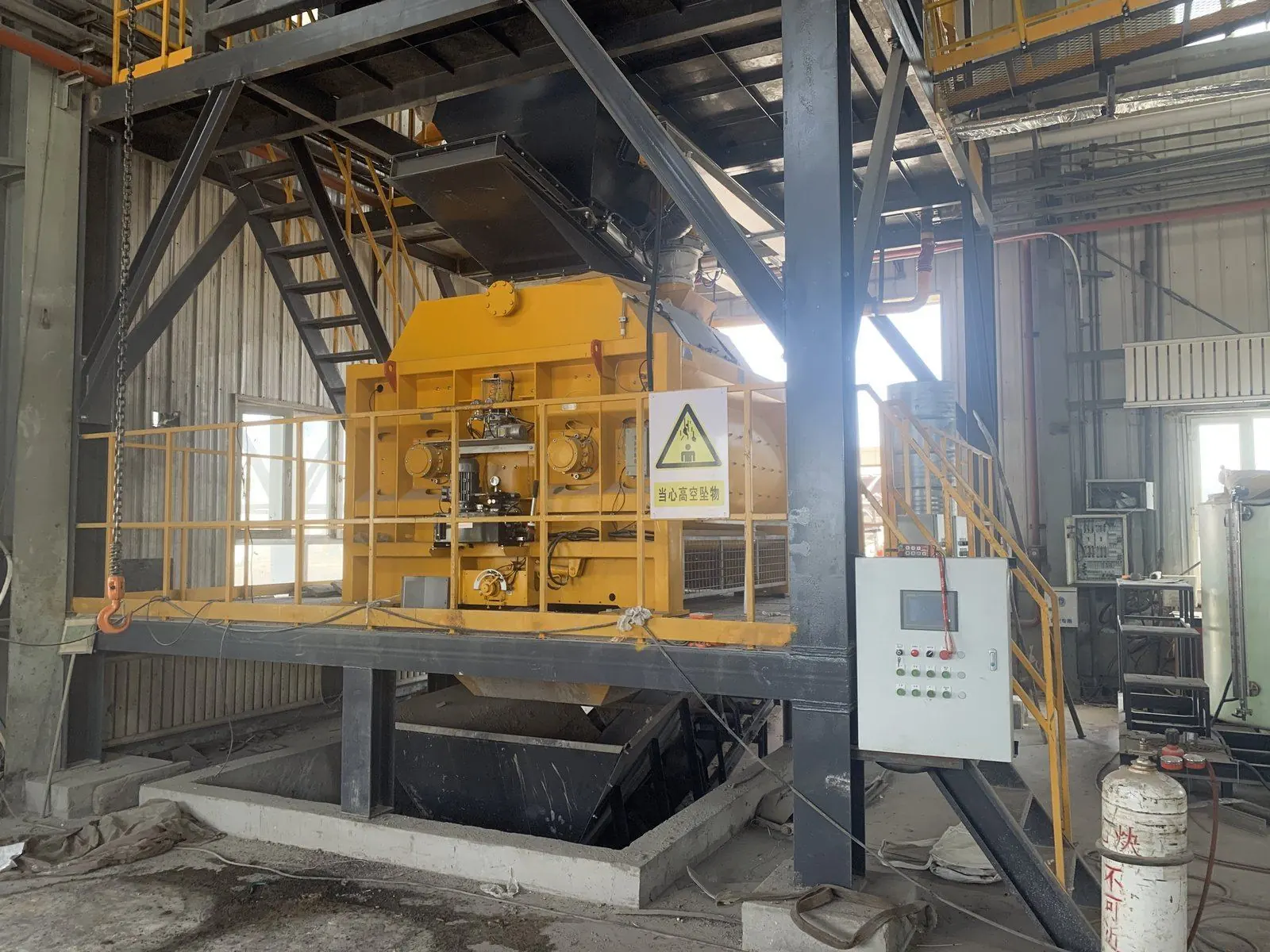
What does each mixer do?
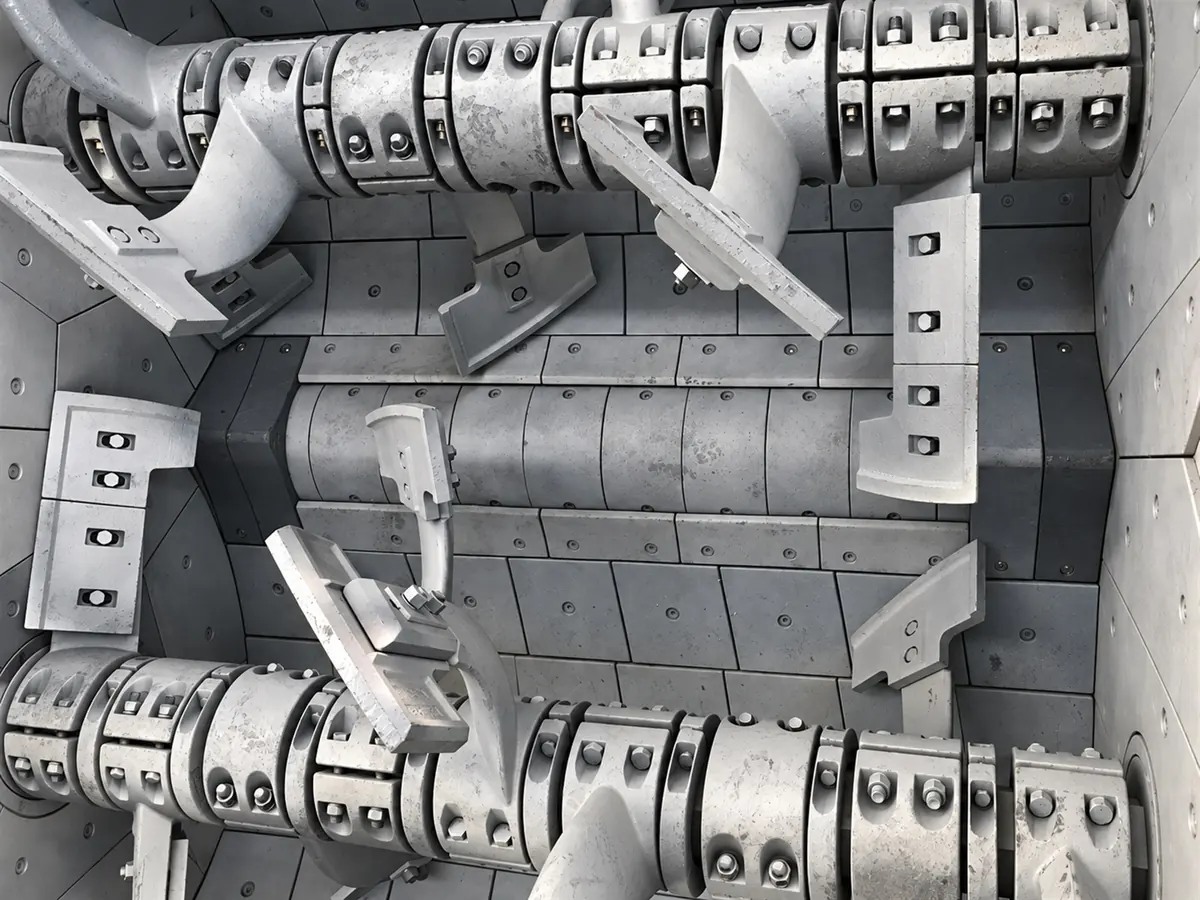
Twin-shaft batch mixer. Two horizontal shafts turn against each other. Paddles set in a broken spiral throw material back and forth between the two paths, so the whole trough is worked at a fairly low speed. The product is a damp, crumbly mix. We build these in our works from 60 L to 3,000 L per batch, and they are the mixer in our stabilization systems.
Intensive mixer. In one common design, a rotating pan moves the material into the working zone of a fast-running rotor set off-centre, and a stationary scraper limits build-up on the wall and bottom. With a suitable unit and operating conditions, mixing and granulation can be done one after the other in the same batch. Whether your ash forms usable granules, and at what liquid addition, mixing time and rotor speed, is established by trials. The units considered here run in batches; continuous intensive mixers also exist. In our lines they are built by us or sourced from partners, depending on the project.
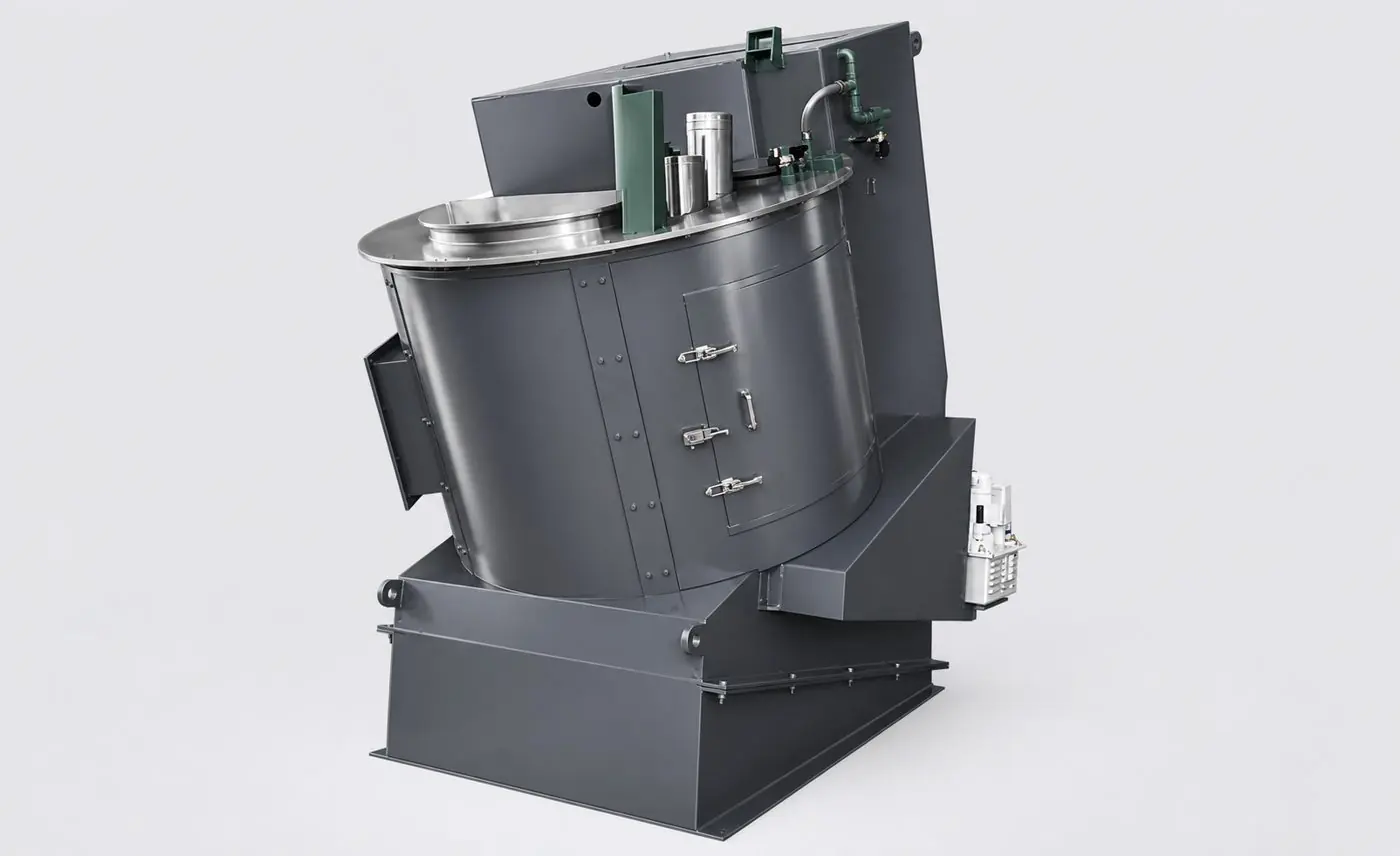
Twin-shaft vs intensive mixer: side by side
| Question | Twin-shaft batch mixer | Intensive mixer with granulation |
|---|---|---|
| Product form | Damp, crumbly mix | Granules, if moisture and recipe allow |
| Moisture control | Water content is controlled to give a damp, workable mix | Granules form only in a moisture range found by trials: too dry stays dusty, too wet turns to paste |
| Reagent and water dispersion | Good for liquid sprayed onto a moving bed | Good; the rotor breaks up lumps and wet spots |
| Wear points | Paddles and bolted liner plates | Rotor tools, pan lining and scraper |
| Maintenance | Paddles and liners changed one at a time; shaft-end seals need attention | Rotor tools changed as wear parts; pan and scraper inspected |
| Suitable downstream handling | Bulk bags, trucks, block forming machine, direct landfill | Conveying, storage or transport where dust matters, if trials confirm the granules survive handling |
| Our status | Core product, built in our works | Configurable solution; specified only after trials, performance confirmed per project |
When is granulation worth it?
Granulation adds a process step that has to be controlled, so it needs a clear reason downstream. It can make sense when:
- treated ash is conveyed, stored or loaded in the open, and dust from a fine product would be a problem;
- the product travels some distance before it is placed, and better flow and less dusting help handling;
- the landfill operator asks for a coarser, less dusty product to place.
A published patent application for a granulation system for dusty waste-to-energy fly ash, using a separate rotating pan granulator, states these aims: easier storage and transport, less dispersion of fines and lower ammonia emission (IT202100023102A1). Those are aims stated for that system, not measured results, and not results for your ash.
Granulation does not replace stabilization, and it does not make granules dust-free: fresh granules can wear and break in drops, screws and loading, so trials should test them after the real transfer and storage steps. The granules still carry the reagent and cement your recipe calls for. They still need curing, and they are still tested against the acceptance criteria that apply to you.
If the product simply drops into bulk bags or a truck and goes to a landfill cell, a twin-shaft mixer is usually the simpler and lower-risk choice.
Process flow: two routes from the same dosing section
| Step | Equipment | Notes |
|---|---|---|
| Ash receiving | Silo with rotary valve and screw, or a bulk-bag unloading station | The same for both routes |
| Weighing | Ash weigh hopper; cement, reagent and water scales (dosing and weighing) | Water dosing accuracy is set and verified for the chosen route |
| Mixing, route A | Twin-shaft batch mixer | Liner chosen from the ash analysis, reagent SDS and wear |
| Mixing, route B | Intensive mixer: mix, then granulate in the same batch | Configurable solution. Granule size and strength confirmed by trials on your ash |
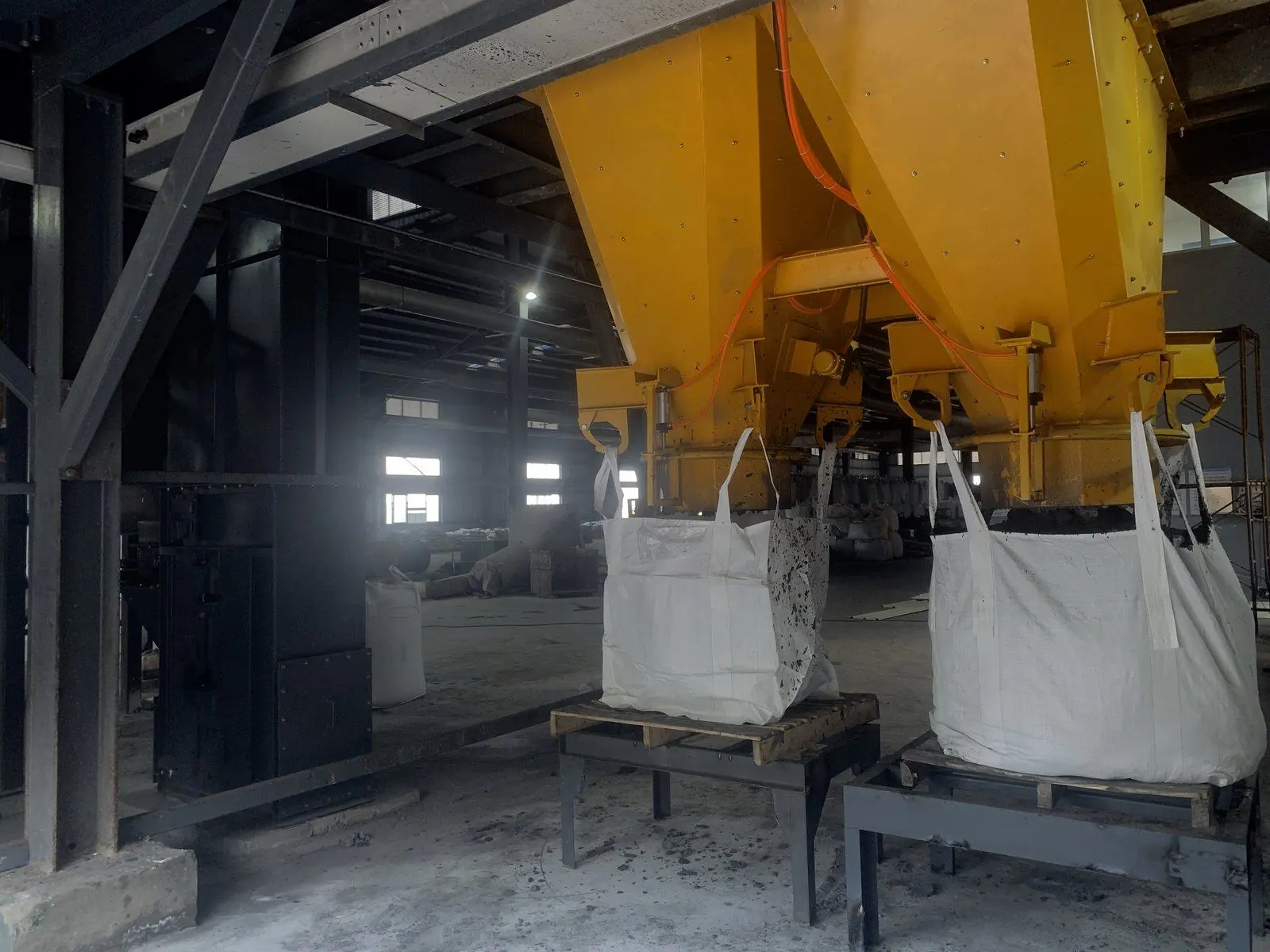
| Discharge | Gate to bags, truck, block forming machine or belt (A); gentle transfer to a granule conveyor (B) | Long drops and screw conveyors can break fresh granules |
| Curing and testing | Curing area or bins, then sampling | Acceptance is confirmed by testing |
A third arrangement is a twin-shaft mixer for stabilization followed by a separate granulator. That may be considered when extending an existing line. It is custom-engineered, subject to engineering review and trials.
Questions we ask before recommending one
- What form must the product have, and where does it go next? This answers most of the question.
- How much does your ash vary? Moisture, particle size and chloride content change with the waste and the flue-gas cleaning. Granulation is less forgiving of that variation than plain mixing.
- Is there trial data? For route B we want granulation trials on representative ash with your recipe before fixing the design. For route A, the lab recipe is the design basis, and mixing and discharge are confirmed at commissioning.
- How abrasive and corrosive is the mix? Twin-shaft liners come in high-chromium alloy, stainless steel or an anti-stick engineering polymer (see the three liners). For an intensive mixer, wear parts and linings are selected with the supplier of the mixing unit.
- What throughput and hours? Both routes are sized by mass per batch and batches per hour. The sizing check is in our guide to configuring an incinerator fly ash stabilization line.
- How much height and floor space is there? Granules need gentle handling after discharge, which can affect the layout.
Reference sizes for the twin-shaft route
Our catalogue reference capacities for twin-shaft lines run from 0.2–0.5 t/h with a 60 L mixer up to 9–18 t/h with a 3,000 L mixer. These are catalogue figures, on the conservative side. The real rate depends on the ash, the recipe and the batch cycle. For the intensive-mixer route we do not quote a reference rate; it follows from trials.
What to send us
- Ash generation (t/day), average and peak, and the hours the line will run
- Ash data, if available: moisture, bulk density, particle size, chloride content, leaching results
- The tested recipe (reagent type and %, cement, water), or tell us it has not been tested yet
- The disposal route and the acceptance criteria that apply
- The product form you need (damp mix or granules) and how it leaves the plant
- Building dimensions and clear height, with photos
- Power supply and site climate
Price and lead time
Price depends on the route, throughput, materials of construction, automation and structural work. Route B usually needs trials before the design is fixed, which adds time at the start. For either route, configuration, price and lead time are confirmed after engineering review of final specifications.
FAQ
Can an intensive mixer replace a twin-shaft mixer on an existing line?
Sometimes, but it changes the moisture control and the discharge handling. We review the dosing section, the layout and trial results before recommending it.
Can one twin-shaft line also treat sludge or contaminated soil?
The same lines also stabilize contaminated soil, river sediment and sludge, with the recipe and liner set for each material.
Not sure which route fits your plant? Send the information above through the enquiry form. An engineer will review it and come back with a preliminary recommendation.
Reviewed by: Jason Li, ZKSJECO