Guides / 未分类
How to Configure an Incinerator Fly Ash Stabilization Line
Plan a stabilization line for waste incinerator fly ash around ash output, test-based dosing, mixing, dust capture and discharge. See the site data we need for preliminary sizing.
Fly ash from municipal solid waste incineration (MSWI) differs from plant to plant, depending on the waste and the flue-gas cleaning process. Two things hold for most of it. It is fine and dusty at dry transfer points, and it can build up and wear parts once water and reagents are mixed in. A stabilization line has to dose accurately, mix thoroughly, contain dust and keep running despite both.
This guide covers how we configure such a line, why each piece of equipment is chosen, and what information we need from you to size it.
1. Start from the disposal route and the recipe
What the treated ash must achieve depends on where it is going. In China, for example, GB 16889-2024 (in force since 1 September 2024) sets conditions for incinerator fly ash entering a municipal landfill, including leachate limits and a dioxin limit. HJ 1134-2020 covers other treatment and disposal routes (GB 16889-2024, MEE; HJ 1134-2020). Other countries have their own acceptance criteria.
The recipe comes from testing a representative sample of your ash. Published studies show how much it can vary. One study tested a dithiocarbamate chelating agent at 2% and 3% additions. Another optimized a combined recipe for lead with about 11.6% cement and 2.8% sodium dihydrogen phosphate (review, Materials 2026). These are laboratory results for particular ashes, not design values.
What the line has to do is dose whatever recipe your tests set, repeatably, and mix it evenly. Whether the product is accepted is confirmed by testing representative samples against the applicable criteria. The equipment cannot guarantee that by itself.
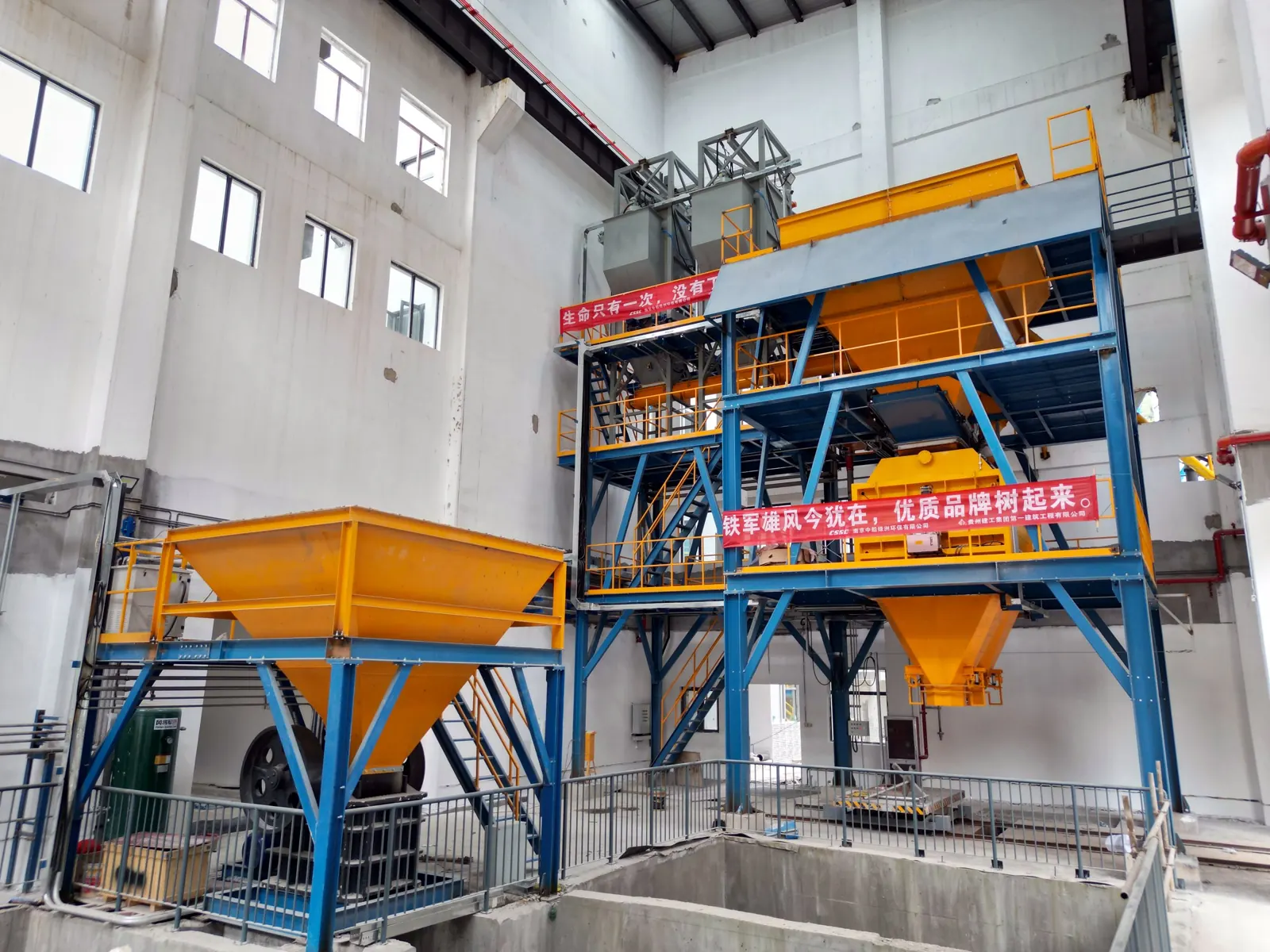
2. The process flow
| Step | Equipment | Why this choice |
|---|---|---|
| Ash receiving | Silo, or bulk-bag (FIBC) unloading station | Where silo space is limited, ash can be fed from bulk bags. An enclosed bag station with extraction controls dust at the opening. |
| Ash conveying | Screw conveyor, or vacuum conveying | Vacuum conveying suits long or awkward routes. We used it on one small line. |
| Ash weighing | Load-cell weigh hopper, vented to a filter | Dosing accuracy starts at the weigh hopper. |
| Cement | Silo, screw feeder, separate weigh hopper | Weighed on its own so the ratio can be adjusted. |
| Chelating agent | Tank and dosing pump. Wetted materials are chosen from the reagent’s SDS and concentration. | On one project the reagent hopper and pump wetted parts were 304 stainless. That is not a universal choice. |
| Mixing | Twin-shaft forced mixer | See section 3. |
| Discharge | Gate, then belt or scraper conveyor | A scraper conveyor fits long runs or layouts too tight for a belt. |
| Control | PLC with touch screen, automatic and manual modes | Each batch’s weights, time and recipe are stored and can be exported for your records. |
3. Sizing and specifying the mixer
For wet, sticky and abrasive mixes we use a twin-shaft forced mixer. Two shafts turn against each other with paddles set in a broken spiral. Material is thrown between the two paths, so the whole trough is worked at fairly low speed.
Size by mass, not volume. A workable check:
dry ash per batch (kg) × batches per hour ≥ design ash throughput (kg/h), with margin
Our model codes give two volumes. In a ZKS225/150, 225 L is the charging volume and 150 L is the discharged volume per batch. Size from the discharged volume per batch, converted to dry ash mass with the ash’s bulk density and the recipe’s liquid-to-solid ratio. The batch cycle includes charging, mixing time set by the recipe, and discharge. Operating hours per day differ from plant to plant, so we size to your hours, not to a fixed shift.
As one example from our projects, a small line with a ZKS225/150 twin-shaft mixer (225 L charging, 150 L discharge per batch, 5.5 kW) was specified at about 1 m³/h of mixed product, for that plant’s fly ash output of 1–2 tonnes per day. Our largest mixers are in the 3,000 L class, built for hazardous-waste stabilization. The same sizing check applies at every scale.
Liners. The trough, shafts and paddles stay the same; the liner material is selected after reviewing the ash analysis, reagent SDS and wear. We offer:
- high-chromium wear-resistant alloy (our standard for abrasive mixes);
- stainless steel;
- an anti-stick engineering polymer (see the three liners).
Liners are bolted in, so worn plates are replaced one at a time.
Maintenance points. Shaft-end seals, liners, paddles, bearings and the discharge-gate seal all belong in the maintenance plan. Wet, fine slurry is hard on seals.
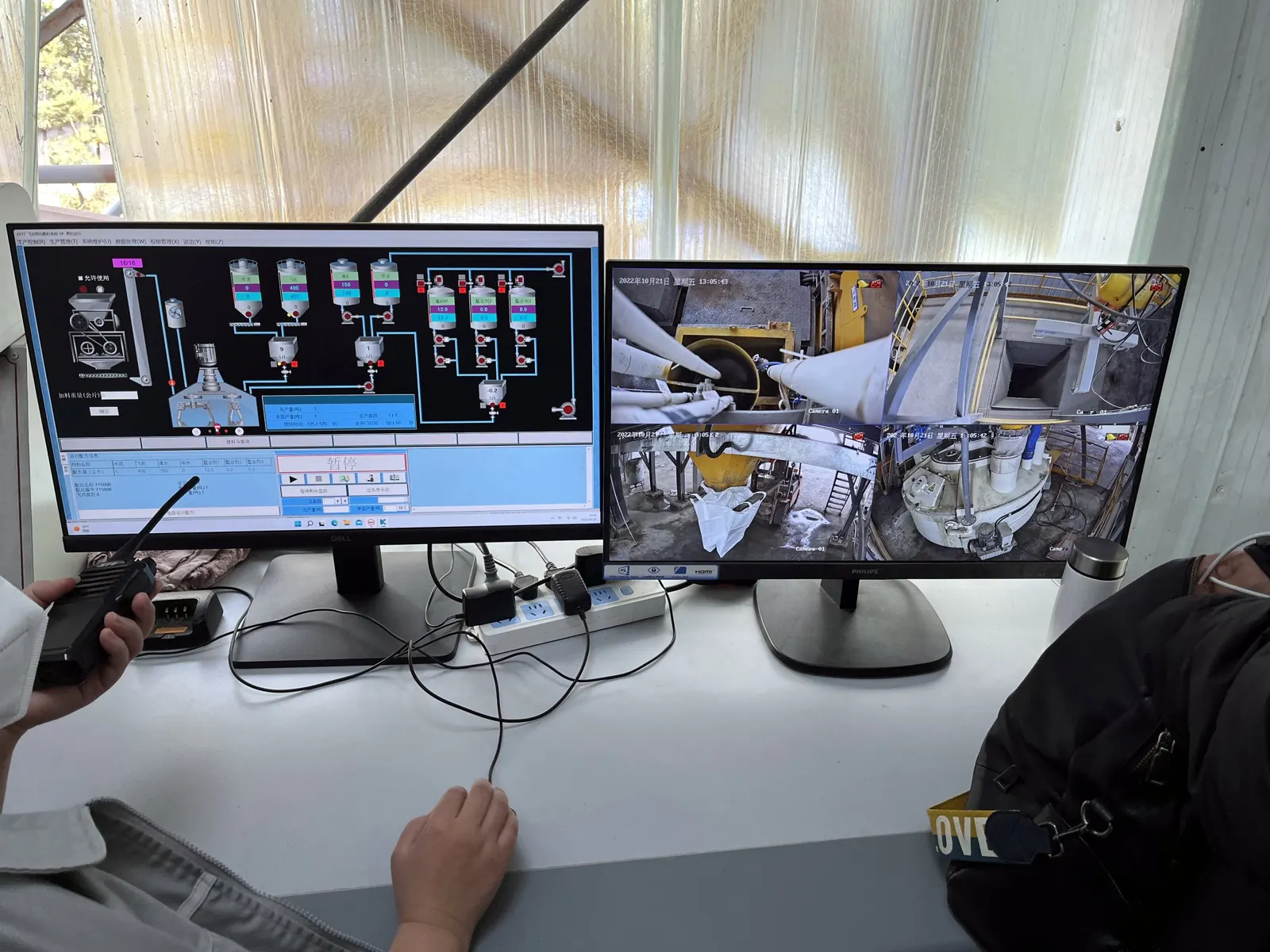
4. Dust control
Dust is released wherever ash falls or displaces air: bag opening, weigh hopper, mixer inlet, conveyor transfers. Collection (dust collectors) can be local, with a filter at each point, or central. The choice depends on the number of pickup points, duct routing and airflow. On the small line above, the feed-side collector was specified at 800 m³/h. That was right for that layout, not a standard value.
5. When there is little space
Some incineration plants did not reserve space for stabilization. For these we configure a compact line. The photos show one we built:
- Bulk-bag feeding instead of a tall silo. An electric hoist lifts the bag onto the discharge station above the weigh hopper.
- Everything on one steel frame. Weigh hopper, mixer and discharge hopper are stacked in a single structure, sized to the room’s clear height.
- Reagent tank and pumps beside the frame, so the liquid dosing line is short.
- A separate inclined conveyor to lift product out to where it can be bagged or loaded.
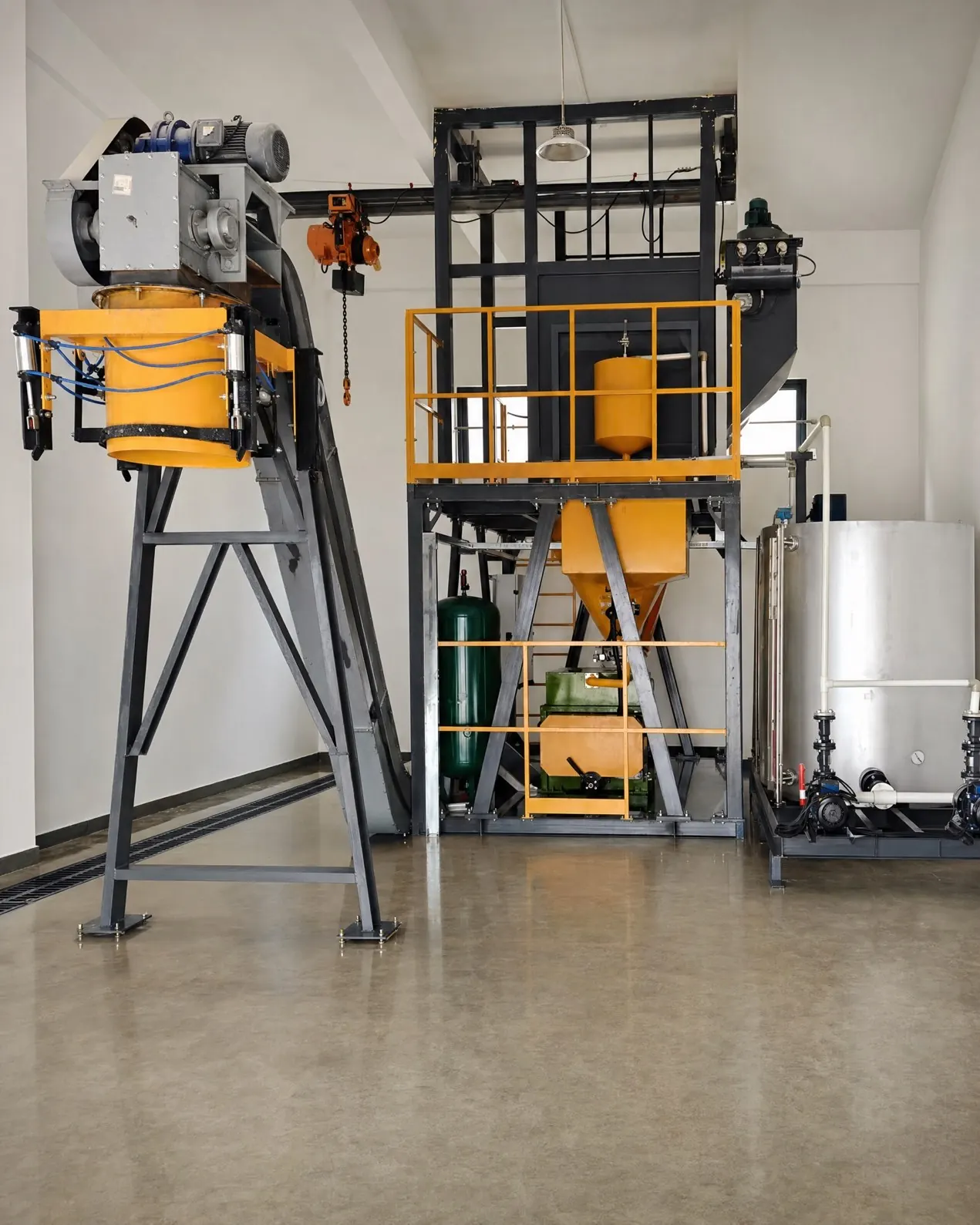
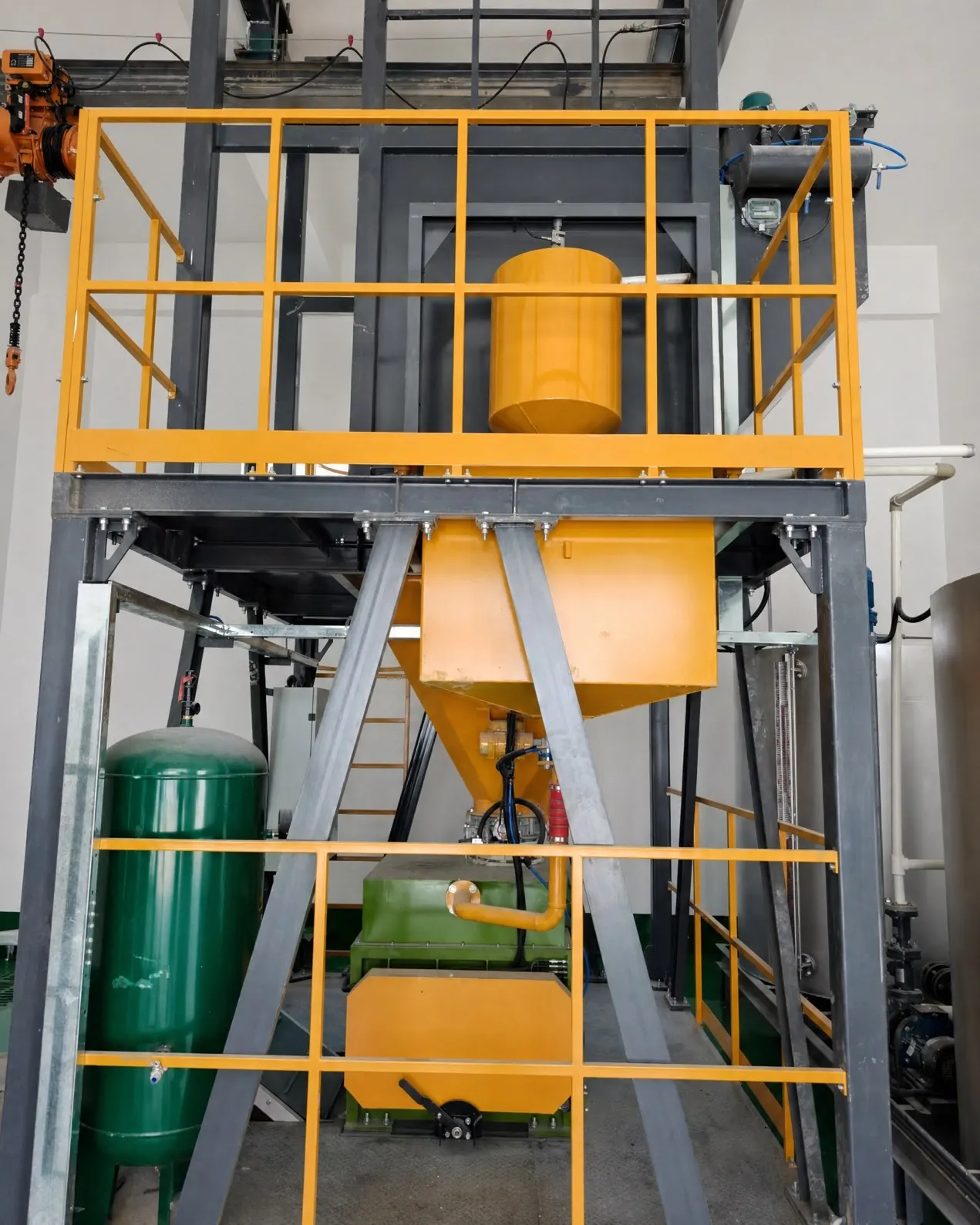
Every compact layout is drawn against the actual building, from your dimensions and photos, before we commit to it.
6. What to send us
- Fly ash generation (t/day), average and peak, and operating hours
- Ash data, if available: moisture, bulk density, particle size, chloride content, leaching results
- The tested recipe (reagent type and %, water, cement), or tell us it has not been tested yet
- The disposal route and the acceptance criteria that apply
- How ash arrives (silo, pneumatic line, bulk bags) and how product leaves (bags, truck, blocks)
- Building dimensions and clear height, with photos
- Power supply and site climate
Price depends mainly on throughput, automation level, materials of construction and structural work. Where a condition is new to us, we say so, and the configuration and lead time are confirmed after engineering review of final specifications.
Planning a stabilization line, or upgrading an old one? Send the information above through the enquiry form. We will review it and discuss a preliminary configuration with you.
More on our stabilization systems.
Reviewed by: Jason Li, ZKSJECO